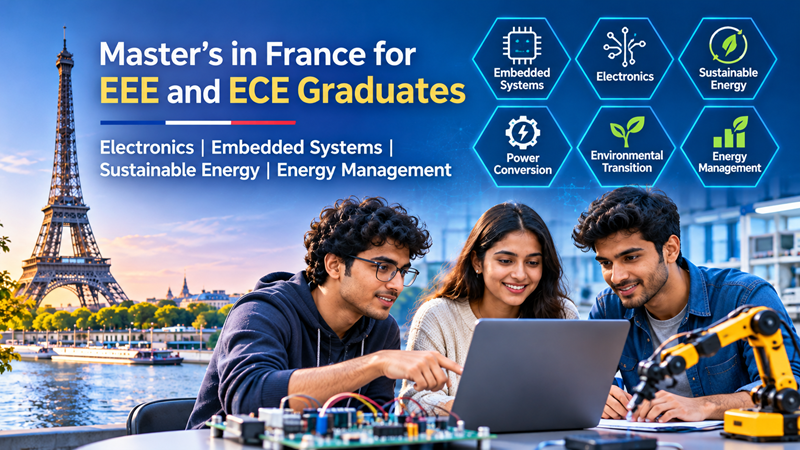
Master's in France for EEE and ECE Graduates - Electronics, Embedded Systems and Energy
BY TRUEMATICS | STUDY IN FRANCE
Are you a graduate in Electrical and Electronics Engineering (EEE) or Electronics and Communication Engineering (ECE) planning to pursue a Master's degree abroad? France offers postgraduate study pathways across electronics, embedded systems, power conversion, sustainable energy and energy management.
These fields connect with several areas of modern engineering, including smart devices, industrial automation, electric mobility, renewable energy, electronic control systems and connected technologies. Depending on your academic background and career goals, you may consider a specialist technical programme or a programme that combines engineering knowledge with energy-sector management.
This guide introduces selected institutions and programmes in France that may be relevant to EEE and ECE graduates. Always check the current programme details and entry requirements with the institution before applying.
Why study in France after EEE or ECE?
France has a broad engineering and higher-education ecosystem, with specialist schools and institutions offering programmes connected to electronics, digital technologies, energy and industrial innovation. Students can explore advanced technical subjects as well as programmes that address the transition towards more efficient and sustainable energy systems.
- Specialized engineering pathways: Explore embedded electronics, microelectronics, power electronics and connected systems.
- Energy-sector opportunities: Study topics related to energy conversion, renewable energy, energy efficiency and energy management.
- Applied learning: Depending on the programme, learning may include laboratory work, engineering projects, case studies and internships.
- International learning environment: Some programmes are designed for international students and delivered in English.
- Career flexibility: Develop skills relevant to electronics, industrial technology, energy, mobility and sustainability sectors.
Popular Master's specializations for EEE and ECE graduates
Embedded Systems
Embedded systems combine hardware and software to perform dedicated functions within products and machines. Applications include automotive electronics, industrial equipment, smart devices, medical technology and the Internet of Things (IoT).
Electronics and Microelectronics
This area focuses on electronic circuits, semiconductor devices, digital systems, sensors, integrated circuits and hardware design. It can be relevant to students interested in electronics development, chip technologies and research-oriented roles.
Power Electronics and Energy Conversion
Power electronics deals with the conversion and control of electrical energy. It is used in electric vehicles, renewable energy systems, industrial drives, power supplies and energy distribution applications.
Sustainable Energy and Energy Management
These programmes explore renewable energy, energy efficiency, decarbonization, energy policy and the management of energy projects. They may suit engineering graduates who want to move towards technical, project or management roles in the energy sector.
Master's programmes in Embedded Systems and Electronics
The following selected programmes are relevant to students interested in electronics, embedded hardware, connected devices and related engineering fields.
1. ISEP - Master's in Embedded Systems
ISEP offers an engineering degree pathway with an Embedded Systems specialization. Its official English-language information describes an engineering programme with an English stream and identifies Electrical and Electronic Engineering among the relevant academic backgrounds for admission. The Embedded Systems pathway is one of its technical specializations.
View ISEP's official programme information
2. JUNIA - Master of Electronics and Embedded Systems
JUNIA's Master of Electronics and Embedded Systems is a two-year programme at its Lille campus. The programme covers areas such as embedded electronics systems, programmable digital circuits, microcontrollers, digital signal processing, power electronics and wireless technologies. Students can explore specializations in Embedded Electronics Systems or Microelectronics and Nanotechnologies.
The institution identifies a Bachelor's degree in Electronics, Digital and Information Technology, IT Engineering, Physics or a related field as a relevant entry background, and specifies B2-level English.
View JUNIA's official programme information
3. ESIGELEC - Master of Technology in Electronic Embedded Systems
ESIGELEC lists a Master of Technology in Electronic Embedded Systems, focused on the design, creation, testing and implementation of embedded systems. The course outline describes academic semesters followed by an internship period and notes the joint award arrangement with INSA Rouen Normandie.
Applicants should check the latest programme brochure to confirm whether the course is currently open, its teaching language, entry route and current award conditions before applying.
View ESIGELEC's programme outline
Master's programmes in Energy, Sustainability and Power Conversion
EEE graduates in particular may also consider programmes connected to power conversion, renewable energy and energy management. Some of these courses are interdisciplinary and include management or environmental subjects alongside technical content.
4. ECE Paris - MSc CGE Sustainable Energy Future
This programme title is included in the selected course list for this article. Before applying, students should request the latest official programme page or brochure from ECE Paris and confirm the current title, teaching language, campus, entry requirements and qualification awarded.
Visit ECE Paris
5. ESAIP - MSc Environmental Transition and Energy Management
ESAIP's MSc in Environmental Transition and Energy Management is taught in English at its Angers campus. The programme combines technical and managerial subjects related to energy and environmental transition. Its curriculum includes renewable energy, energy efficiency, environmental sciences, energy economics, energy policy, energy audits and energy management.
ESAIP describes the award as a Level 7 degree delivered by the institution and validated by the Conférence des Grandes Écoles (CGE). Applicants should review the programme's academic prerequisites and confirm suitability for their undergraduate specialization.
View ESAIP's official programme information
6. ESME - Master Program in Power Conversion Management
ESME's Master Program in Power Conversion Management focuses on designing energy optimization systems and managing their implementation. The subject area includes electrical energy conversion, motor control, energy production and distribution, and applications in sectors such as automotive, aerospace, robotics and industry.
This programme may be relevant to students with an electrical engineering background who want to specialize in power conversion and energy systems. Check the current admissions requirements and course details directly with ESME.
View ESME's official programme information
7. emlyon business school - MSc in Management of Energy Transitions
emlyon's MSc in Management of Energy Transitions focuses on the business and management dimensions of the energy transition. The programme addresses energy markets, decarbonization, energy supply chains and the development of energy projects. It is an interdisciplinary option for graduates who wish to combine their prior engineering education with energy-sector management.
emlyon indicates that applicants may be considered for Year 1 with a three-year Bachelor's degree, or Year 2 with a four-year Bachelor's degree or a Master's degree, subject to the programme's assessment. Applicants should check the current admissions page for the latest requirements.
View emlyon's official programme information
8. IMT Atlantique - MSc Nuclear Engineering / track Nuclear Energy Production and Industrial Applications
Nuclear Energy Production & Industrial Applications specializes in nuclear sciences applications including energy production (power reactors) and industrial applications (particles beams technology, instrumentation,.....). A particular focus is put on the safety and radioprotection, to be considered in the management of a large project in this field.
IMT Atlantique indicates that applicants may be considered for Year 1 with a four-year Bachelor's degree. Applicants should check the current admissions requirements with us before starting the application.
View IMT Atlantique official programme information
Important: Check the exact qualification and programme status
Programme titles and course availability can change. The terms MSc, Master of Technology, Master's degree, engineering degree and Level 7 qualification do not necessarily describe identical awards. For each programme, confirm the exact diploma awarded, accreditation or recognition, campus, teaching language, duration and current admission route with us before starting the application.
Eligibility requirements for Indian EEE and ECE students
Admission requirements differ by institution and programme. A Bachelor's degree in Electrical and Electronics Engineering, Electronics and Communication Engineering, Electronics Engineering or a closely related discipline may be relevant, but the institution makes the final decision based on the student's academic record and subject background.
Common application documents may include:
- Four-year BE/BTech degree certificate or provisional certificate, where applicable.
- Academic transcripts and consolidated mark sheets.
- Updated resume or curriculum vitae.
- Statement of purpose or motivation letter.
- Letters of recommendation, if requested.
- English-language proficiency evidence, if required.
- Passport copy and any additional documents requested by the institution.
Some programmes may expect prior coursework in electronics, programming, mathematics, control systems, electrical machines or related technical subjects. Energy-management programmes may assess applicants on a broader set of academic and professional factors.
English language requirements
Some Master's programmes in France are delivered fully in English, while others may have French-language requirements or different language tracks. Confirm the teaching language for the exact programme and campus before applying.
Depending on the institution, applicants may be asked to submit IELTS, TOEFL, TOEIC or another accepted English-language test. Some institutions may consider alternative evidence, such as a Medium of Instruction letter, under their own exemption policies.
Do not assume that an English-taught programme automatically waives IELTS or another test. Check the required test, minimum score and exemption rules directly with the admissions office.
Tuition fees and cost of living in France
Tuition fees vary by institution, programme and academic year. Private engineering schools and business schools may have different fee structures, and additional costs may apply for registration, student services or other charges.
When preparing your budget, account for:
- Tuition fees and institutional charges.
- Accommodation and housing deposits.
- Food, local transport and personal expenses.
- Health insurance and other applicable student costs.
- Visa-related expenses, travel and initial settlement costs.
Always request the latest official fee schedule for the intended intake. Avoid relying on older fee information or estimates from unofficial sources.
Career opportunities after graduation
Career options depend on the programme, your previous education, technical skills, project experience, internships, language ability and employer requirements. Possible areas of work include:
- Embedded Systems Engineer
- Electronics Design Engineer
- Hardware or Firmware Engineer
- Microelectronics or Semiconductor Engineer
- Power Electronics Engineer
- Electrical Systems Engineer
- Renewable Energy Project Engineer
- Energy Analyst or Energy Consultant
- Energy Project Manager
- Sustainability or Energy Transition Specialist
French language skills can be valuable when seeking internships and employment, particularly in workplaces where French is used with colleagues, suppliers or customers. Students should check the residence and work rules applicable at the time they complete their studies.
Frequently asked questions
1. Can EEE students pursue a Master's in Embedded Systems in France?
Yes, EEE graduates may be eligible for selected Embedded Systems and Electronics programmes, depending on the curriculum of their Bachelor's degree and the institution's entry requirements.
2. Can ECE students apply for Energy-related Master's programmes?
Some interdisciplinary energy programmes may consider ECE graduates, but eligibility depends on the programme's prerequisites. Students should confirm whether their academic background meets the required level in electrical engineering, energy or related subjects.
3. Are these programmes taught in English?
Teaching language varies by institution and programme. Some of the listed programmes publish English-language course information, but students should confirm that the full programme is delivered in English for their intended intake.
4. Is IELTS mandatory for admission in France?
Not in every case. Each institution sets its own language requirements and exemption rules. Check whether IELTS, TOEFL, TOEIC or another form of evidence is accepted.
5. Can I apply directly to the second year of a Master's programme?
Some institutions may consider direct entry to a later year depending on the applicant's previous degree, academic subjects and relevant experience. This is assessed individually and should never be assumed.
6. Are Energy Management programmes suitable for EEE graduates?
They may be suitable for graduates interested in renewable energy, energy efficiency, energy markets or project management. However, these programmes may be less focused on core electrical engineering than a specialist power systems or power electronics course.
7. Can Truematics help with applications to France?
Truematics can assist with programme shortlisting, profile assessment, application documentation and study-abroad guidance. Admission decisions are made by the respective institutions.
Not sure which Master's programme in France matches your EEE or ECE background?
Share your Bachelor's degree, academic marks and preferred specialization. Our counsellors can help you review suitable options in France.
Chat with a France Counsellor on WhatsApp
Apply for a Master's programme in France with Truematics
Choosing a Master's programme requires careful comparison of the course content, entry requirements, teaching language, qualification awarded, tuition fees and career direction. A programme in Embedded Systems may suit a different career goal from one in Energy Management or Sustainable Energy.
Truematics provides study-abroad counselling and application support for Indian students interested in studying in France. We can help you review programme options, assess your academic profile, prepare application documents and plan the next steps.
To learn more, visit our Study in France page or contact our team for counselling.
Plan your Master's in France
Get guidance on Embedded Systems, Electronics, Sustainable Energy and Energy Management programmes in France.
TRUEMATICS - Study Abroad
Enquire on WhatsApp
Disclaimer: Programme names, availability, teaching language, fees, admission criteria and qualifications may change. Information should be reconfirmed with the institution's official admissions team before applying. Admission, visa and residence decisions are made by the relevant institutions and authorities.