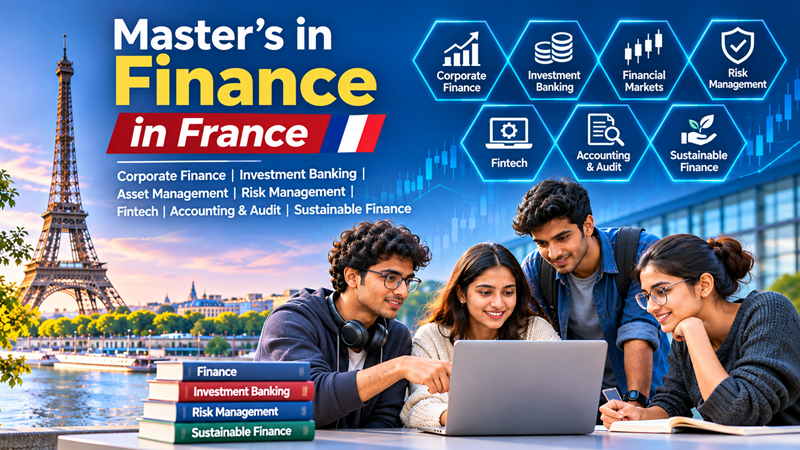
Master's in Finance in France for Indian Students
BY TRUEMATICS | STUDY IN FRANCE
Are you a commerce, accounting, economics, business or engineering graduate planning to build an international career in finance? France offers postgraduate options in corporate finance, investment banking, financial markets, asset management, accounting, auditing, fintech, risk management and sustainable finance.
Some programmes focus on corporate financial decisions, valuation, mergers and acquisitions and investment strategy. Others concentrate on banking, capital markets, portfolio management, financial data, auditing or environmental, social and governance (ESG) finance. This guide brings together the finance-related programmes from the shortlist supplied for this article. Programme titles, campuses, study routes and qualifications should be checked against the institution's latest information before applying.
Why study Finance in France?
France has an established financial services sector and is home to international banks, insurance companies, investment firms, consulting organisations and major corporate groups. Paris is an important European business and financial centre, while other cities offer business-school programmes with their own industry links.
- Specialised study options: Corporate finance, investment banking, asset management, financial markets, auditing, fintech and sustainable finance.
- International learning environment: Many business schools offer English-taught programmes.
- Practical learning: Depending on the course, students may complete case studies, financial simulations, company projects, internships or a professional thesis.
- Emerging finance areas: Sustainable finance, ESG analysis, fintech and financial data feature in specialist programmes.
Popular Master's specialisations in Finance
Corporate Finance
Focuses on how companies raise capital, evaluate investments, manage cash flow and make strategic financial decisions. Topics may include valuation, financial modelling, mergers and acquisitions and capital structure.
Investment Banking and Financial Markets
Explores capital markets, securities, fixed income, equity research, investment banking, financial instruments and transactions.
Asset Management and Investment Research
Concentrates on portfolio construction, equity and credit research, asset allocation and investment analysis.
Banking and Risk Management
Deals with banking operations, financial regulation, credit and market risk, risk modelling and financial institutions.
Accounting, Auditing and Management Control
Combines financial reporting, accounting standards, audit, internal control, management accounting and budgeting.
Fintech and Financial Data
Explores the relationship between finance and technology, including data analytics, digital financial services and financial information systems.
Sustainable and Impact Finance
Examines how ESG considerations influence investment decisions, corporate finance, responsible investment, impact investing and financial risk.
Selected Master's programmes in France
The following list follows the institutions and programme names supplied for this article. Some institutions offer several pathways within one MSc; others offer a broader management degree with a finance specialisation. Confirm the exact intake, campus, language, entry level and qualification with the school.
1. SKEMA Business School
- MSc Auditing, Management Accounting & Information Systems - relevant to audit, management accounting, financial information systems and control.
- MSc Corporate Financial Management - listed for Lille and Sophia Antipolis; focused on corporate finance and financial management.
- MSc Sustainable Finance & Fintech - combines finance with sustainability and technology-related themes.
Confirm current programme titles, campus availability and entry route directly with SKEMA. Visit SKEMA's programme website.
2. NEOMA Business School - MSc International Finance
NEOMA's MSc International Finance includes three concentration tracks in the supplied shortlist. They are specialisation choices within the MSc, rather than three unrelated programme titles:
- Corporate Finance & Investment Banking - corporate financial strategy, transactions and investment banking.
- Asset Management & Investment Research - portfolio management, equity and credit research and investment analysis.
- Financial Markets & Risk Management - financial instruments, markets and risk-related roles.
NEOMA describes a core programme followed by a concentration track. Its published information also describes a two-year route for applicants with a three-year Bachelor's degree through an International Pre-Master option. View NEOMA's MSc International Finance.
3. ESCE International Business School - MSc in International Corporate Finance
ESCE's MSc in International Corporate Finance is taught in English. The programme information refers to corporate finance, investments and financial intermediation, with subjects including advanced corporate finance, derivatives, money and banking, fixed-income securities, mergers and acquisitions, working capital management and international banking regulation. ESCE describes the qualification as RNCP Level 7, equivalent to Bac+5. View ESCE's official programme page.
4. ICN Business School - MSc in Corporate Finance & Tech
ICN lists an MSc Corporate Finance & Tech at its Paris campus. The programme is described as English-taught and full-time, bringing together finance and technology. Check the current intake and admissions requirements. View ICN's MSc Corporate Finance & Tech.
5. IESEG School of Management
- Master in Finance - covers financial analysis, banking, capital markets, financial technology and asset management. Taught in English in Paris.
- Master in International Accounting, Audit & Control - focuses on financial reporting and analysis, management accounting, decision-making, corporate finance and financial advisory services. Taught in English in Paris.
Important for Indian applicants: IESEG's published information states that, under the bilateral agreement between India and France, Indian students are required to take the Regular Track, regardless of the length of their Bachelor's degree. Confirm the applicable structure directly with IESEG. IESEG Specialized Masters | International Accounting, Audit & Control.
6. KEDGE Business School
- MSc Ecological and Impact Finance - finance connected with environmental transition, sustainability and impact.
- MSc Banking and Finance - banking, financial institutions and finance-sector careers.
Check the current programme pages for exact titles, campus, duration, language and qualification. Visit KEDGE's programme portal.
7. Rennes School of Business
- MSc International Finance - international financial activities.
- MSc Financial Data Intelligence - finance combined with data and analytical skills.
- MSc International Accounting, Management Control & Auditing - financial reporting, management control and auditing.
The school's programme catalogue lists English-taught options with one or two year routes depending on entry level. It identifies Rennes as the campus for Financial Data Intelligence and International Accounting, Management Control and Auditing; International Finance is listed at Paris and Rennes. Confirm with us the campus for your intake. View Rennes School of Business MSc programmes.
8. Montpellier Business School - MSc Global Finance
Request the latest programme brochure to verify the current course title, curriculum, teaching language, campus, duration, admission requirements and qualification awarded. Visit Montpellier Business School.
9. Toulouse Business School (TBS Education)
- MSc Banking & International Finance - listed at the Paris campus and focused on banking and finance-sector competencies.
- MSc Sustainable Financial Management with Data Analytics - combines corporate finance, ESG principles and data analytics. Important: TBS currently lists this programme at its Barcelona campus, Spain, not France. It is not a France-campus option.
- MSc Finance - listed at Toulouse and designed to develop specialised finance knowledge.
TBS lists English-taught study routes, with one or two year formats depending on academic background for programmes shown in its finance catalogue. View TBS Education finance programmes.
10. Excelia Business School
- MSc Sustainable Finance - finance focused on sustainability related financial decisions and responsible investment.
- MSc International Corporate Finance - taught in English at La Rochelle, with subjects including financial analysis and reporting, financial modelling, sustainable finance, equity analysis, portfolio management, valuation, mergers and acquisitions and international financial markets.
Excelia describes its International Corporate Finance MSc as a 12 or 24-month format depending on previous higher education and identifies the qualification as a French Grade de Master. Confirm the current details of the Sustainable Finance programme separately. View Excelia MSc International Corporate Finance.
11. ISC Paris - MSc Finance & Risk Management
ISC Paris's MSc Finance and Risk Management combines finance with the analysis and management of financial and corporate risks. The programme information describes theoretical study and company immersion, and refers to state accreditation and RNCP registration. View ISC Paris MSc Finance and Risk Management.
12. Paris School of Business - MSc in International Finance
Your shortlist identifies the MSc in International Finance. Paris School of Business currently also lists a Master in Financial Risk Management in English. Contact the school to confirm the exact finance programme available for your intended intake and whether the International Finance title remains open. View Paris School of Business programmes.
13. EM Normandie - MSc Environmental, Social, Governance & Sustainable Finance
This MSc is taught entirely in English at the Paris campus. The curriculum includes advanced financial analysis, ESG regulations and disclosures, fintech and applied sustainable finance, impact investing, international finance, portfolio management, corporate valuation and ESG risk management. EM Normandie describes it as a five-year degree level approved by the French Ministry of Higher Education and Research, and also lists a two-year route for eligible applicants with a three-year higher education qualification. View EM Normandie's official programme page.
14. ESDES School of Business and Management - MSc Impact Finance and Fintech Management
ESDES is included for its MSc Impact Finance and Fintech Management. The programme title brings together impact-oriented finance and financial technology. Consult the current programme information to confirm curriculum, campus, teaching language, duration, admission route and qualification. Visit ESDES.
15. EDC Paris Business School - MSc International Finance
EDC Paris is included for its MSc International Finance. Request the current brochure and verify the exact programme title, specialisations, campus, teaching language, duration, admission requirements and qualification awarded. Visit EDC Paris Business School.
Important: Check the exact qualification and campusNot every programme marketed as an MSc or Master's has the same academic status. A French Grade de Master, a state-recognised diploma, an RNCP Level 7 professional certification and an institutional MSc award are different types of recognition and should not be treated as interchangeable. Ask each school to confirm the precise qualification and recognition in writing.
TBS Education's MSc Sustainable Financial Management with Data Analytics is listed at Barcelona, Spain. It is not a France-campus programme. Some entries in this shortlist also require direct confirmation of their current title and availability before being promoted as open for applications.
Eligibility for Indian students
Admission requirements depend on whether the course is a one-year specialist MSc, a two-year route or a specialised Master's programme. Schools may assess the applicant's degree subject, academic performance, quantitative background, English proficiency, motivation and work experience.
Relevant undergraduate backgrounds may include B.Com, BBA, BBM, BMS, Economics, Finance, Accounting, Banking, Management, Mathematics, Statistics or Engineering, where accepted by the institution.
Common application documents include academic transcripts, degree certificates, CV, statement of purpose, passport copy, English-language test results and recommendation letters where requested. Some programmes may require an interview or aptitude assessment.
Some schools offer two-year routes for applicants with a three-year Bachelor's degree, while other one-year programmes may require a four-year degree or equivalent. IESEG has a specific Regular Track requirement for Indian students, so applicants should check this carefully.
English language requirements
Several programmes in the shortlist are advertised as English-taught. Depending on the school, applicants may be asked for IELTS, TOEFL, TOEIC, Cambridge or another accepted English test. Some institutions may consider a Medium of Instruction certificate or waive the test under their own policy, but this is not automatic. Check accepted tests, minimum scores, validity and waiver conditions directly with the school. French is not necessarily required for admission to an English-taught course, but it can help with internships, networking and employment.
Tuition fees and living expenses in France
Tuition fees vary by business school, programme, campus, duration and entry route. A one-year MSc, a two-year programme and a specialised Master's pathway can have different fee structures. Additional costs may include application, registration, student services, insurance and study materials.
Students should also budget for accommodation, food, local transport, health insurance, personal expenses and visa-related costs. Paris generally requires a higher living budget than many other French cities. Request a written fee schedule covering the full course, deposit, instalment dates, refund policy and additional charges. Prepare financial documents in line with current French student visa requirements.
Career opportunities after a Master's in Finance
Depending on the programme, academic background, practical experience and language skills, graduates may explore roles across banks, investment firms, insurance companies, consulting firms, audit firms, fintech companies and corporate finance departments.
- Financial Analyst
- Corporate Finance Analyst
- Investment Banking Analyst
- Equity Research Analyst
- Asset Management Analyst
- Portfolio Analyst
- Risk Analyst
- Credit Analyst
- Financial Controller
- Audit or Assurance Associate
- Management Accountant
- ESG or Sustainable Finance Analyst
- Fintech Business or Financial Data Analyst
These are possible career directions, not guaranteed outcomes. Hiring requirements vary by employer and role. Technical skills, internships, networking and French-language ability can help graduates prepare for the job market.
Frequently asked questions
Can Indian students study Finance in France?
Yes. Indian students can apply to eligible finance-related Master's programmes if they meet the institution's academic, language and other admission requirements.
Which Bachelor's degree is suitable for a Master's in Finance?
Commerce, accounting, finance, economics, business and some quantitative or engineering degrees may be accepted. The required background differs by programme.
Can a student with a three-year B.Com or BBA apply?
Some institutions offer two-year routes for applicants with a three-year Bachelor's degree. Other programmes require a four-year degree or equivalent for direct entry. Each school assesses the applicant's qualification.
Are finance Master's programmes in France taught in English?
Many programmes in this shortlist are offered in English, but the teaching language must be checked for the exact programme, campus and intake.
What is the difference between Corporate Finance and Investment Banking?
Corporate Finance focuses on financial decisions within companies, including funding, investment, valuation and planning. Investment Banking generally focuses on services such as capital raising, mergers and acquisitions and financial transactions for clients.
What is Sustainable Finance?
Sustainable Finance considers environmental, social and governance factors in financial decisions. It can include ESG analysis, responsible investment, impact investing, green finance and sustainability-related risk management.
Does a Master's in Finance guarantee a job in France?
No. Employment depends on skills, experience, language ability, employer requirements, market conditions and applicable work authorisation rules. Completing a programme does not guarantee a job.
Planning to study Finance in France?Truematics can help you compare finance specialisations, understand admission routes, prepare application documents and plan your student visa process.
Enquire on WhatsApp
Get admission guidance from Truematics
Choosing the right finance programme involves more than comparing course names. Consider your Bachelor's degree, academic performance, career goals, preferred specialisation, tuition budget, campus, programme duration and the qualification awarded.
Truematics supports Indian students planning to study in France with programme shortlisting, admission guidance, application documentation and student visa assistance.
Explore Master's programmes in France
Speak with our France education counselling team to discuss your profile and shortlist suitable programmes in Finance, Corporate Finance, Banking, Accounting, Fintech and Sustainable Finance.
Chat with Truematics on WhatsApp
Explore study options in France
Programme information is indicative and based on the supplied shortlist and available institutional programme information. Programme availability, fees, admission criteria, language requirements, campus and award details may change. Applicants should verify all details with the institution before applying.