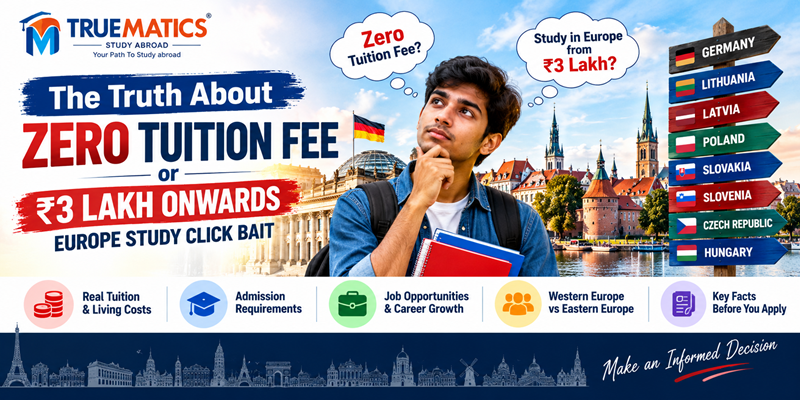
The Truth About Zero Tuition Fees or “Study in Europe from ₹3 Lakh”: What Indian Students Must Know
BY TRUEMATICS | Study Abroad Awareness Guide
Every year, Indian students and parents explore opportunities to pursue higher education abroad. At TRUEMATICS – Study Abroad, we receive enquiries for destinations such as the UK, USA, Australia, Canada, New Zealand, France, the Netherlands, Sweden, Spain, Singapore, Malaysia, Dubai and several other countries.
In recent times, however, we have noticed a growing number of enquiries about “zero tuition fees in Europe” and “study in Europe from ₹3 lakh onwards.” These offers are widely promoted through YouTube, Instagram and other social media platforms.
Naturally, students and parents want to know: Is it really possible to study in Europe at such a low cost? Are these opportunities suitable for every student? And what happens after graduation?
Our intention is not to discourage students from studying in Europe or to criticise any particular country or education consultant. It is to help students and parents understand the facts, evaluate their options and make informed decisions before investing their money and time.
1. Germany and Zero Tuition Fees: What Is the Reality?
Germany has been a popular destination for international students because many public universities offer programmes with no tuition fees or relatively low tuition fees. However, the availability of affordable education does not mean that admission is easy or guaranteed.
Students applying for English-taught engineering-related master's programmes at German public universities need to consider several factors.
Academic eligibility: Applicants generally need a recognised bachelor's degree in a relevant field. The degree, university recognition and academic background must meet the requirements of the particular master's programme. The anabin database can help students understand how foreign universities and qualifications are classified, but university recognition alone does not guarantee admission.
Academic performance: Some programmes are highly competitive and attract applicants with strong academic records. The minimum percentage required varies considerably by university and programme. There is no universal rule that every German public university requires 75% or 80%.
APS and dMAT requirements: Indian applicants should check the current Academic Evaluation Centre (APS) requirements for their applicant category and intended intake. The dMAT requirement applies to specified categories of applicants, subject to the applicable rules and transition provisions. Students should verify their individual eligibility rather than assume that every applicant follows an identical process.
English-language requirements: Students applying for English-taught programmes may need to demonstrate English proficiency through IELTS, TOEFL or other evidence accepted by the university. Requirements vary by programme. Visa documentation and university admission requirements should be checked separately.
Programme-specific selection: Meeting the minimum eligibility criteria does not necessarily mean receiving an offer. The university may consider subject prerequisites, grades, relevant coursework, aptitude requirements and the number of qualified applicants.
Germany's public universities can provide excellent opportunities, but students should assess their eligibility realistically before paying anyone for admission-processing assistance.
2. How Competitive Are English-Taught Engineering Master's Programmes in Germany?
To understand the competition, it is useful to examine the availability of English-taught engineering-related master's programmes rather than look at all German universities collectively.
Students can explore the DAAD International Programmes database and specialist programme directories to identify relevant courses. However, the number of programmes changes depending on the subject, degree level, language of instruction, institution type and intake.
For illustration, suppose a filtered list contains 429 relevant master's programmes.
If we assume an average of 30 available places per programme, the calculation would be:
- Number of programmes: 429
- Assumed places per programme: 30
- Illustrative total capacity: 12,870 places
This is a hypothetical estimate, not an official count of available seats. Actual programme capacity varies, and the number of places open to international applicants may not be publicly disclosed.
Furthermore, applicants compete internationally. Indian students apply alongside candidates from many other countries. It is therefore important to distinguish the total number of programmes from the number of applicants admitted to them.
India produces a very large number of engineering graduates every year, and Germany attracts substantial interest from Indian students. However, without verified programme-level capacity and admission data, we should not claim that a specific number of Indian students receive these places annually.
The practical lesson is clear: low tuition fees do not remove the academic competition involved in securing admission.
Students should research suitable programmes, check eligibility carefully and apply strategically rather than assume that an advertisement promising zero tuition fees means they can easily secure a place.
3. What Does “Study in Europe from ₹3 Lakh” Actually Mean?
Another common promotional phrase is “Study in Europe from ₹3 lakh onwards.”
The important question is: What does that amount cover?
Does it refer to annual tuition fees? The first instalment? A particular course? Or the entire cost of studying abroad?
These are very different things.
A university may advertise a low starting tuition fee for a particular programme. However, the student may also need to pay for accommodation, food, health insurance, visa-related expenses, travel, books, local transport and other personal costs.
Some courses may have lower fees than others, and costs can vary between universities and cities. A starting price does not necessarily represent the typical cost of a two-year master's degree.
Before choosing a university, students should request a complete written cost estimate covering:
- Tuition fees for the entire programme
- Accommodation and living expenses
- Health insurance and other mandatory charges
- Visa, documentation and travel expenses
- Any applicable consultancy or service charges
- An emergency fund and allowance for unexpected expenses
A low advertised tuition fee may be genuine. The problem arises when students mistake it for the total investment required to complete their education.
Not sure how to compare your study-abroad options?Discuss your academic profile, destination preferences and overall budget with TRUEMATICS before making a decision.
Chat with TRUEMATICS on WhatsApp
4. Are Low-Cost European Universities Always the Best Choice?
Countries such as Lithuania, Latvia, Poland, Slovakia, Slovenia, the Czech Republic and Hungary offer international education opportunities. Some universities in these countries provide English-taught master's programmes at tuition fees that are lower than those charged by many institutions in Western Europe.
These countries should not be dismissed simply because they are in Central or Eastern Europe. They have universities, employers and graduates with genuine achievements.
However, students should not assume that every European country offers identical career opportunities, salaries, employer networks or post-study options.
In some cases, students initially approach a consultant because they want to study in Germany. If they do not receive a suitable German university offer, they may be presented with alternatives in other European countries.
An alternative can be a sensible decision if the course fits the student's academic background, budget and career objectives. It becomes a concern when the alternative is presented as equivalent to the original destination without explaining the differences.
Before accepting an alternative offer, students should ask:
- Why is this particular country being recommended?
- Is the university suitable for my intended career?
- What are the employment opportunities in my field?
- What language skills will employers expect?
- What is the full cost of the degree?
- What are my options if I do not find a relevant job after graduation?
The right decision should be based on the student's goals—not simply on whether the university is located somewhere in Europe.
5. Lithuania: Understanding the Real Cost of a Two-Year Master's Degree
Let us examine two examples of Lithuanian universities offering master's programmes relevant to engineering and related fields.
The following figures are illustrative planning estimates based on the tuition and living-cost assumptions shown. Students must confirm the current fees for their chosen programme and intake directly with the university.
Example 1: VILNIUS TECH
VILNIUS TECH is located in Vilnius, the capital of Lithuania.
| Expense | Estimated cost |
|---|
| Average annual tuition fee | €6,450 |
| Programme duration | 2 years |
| Estimated tuition for 2 years | €12,900 |
| Estimated living expenses per year | €4,200 |
| Estimated living expenses for 2 years | €8,400 |
| Estimated total for 2 years | €21,300 |
Using an illustrative conversion of approximately ₹106 per euro, the estimated total is around ₹22.6 lakh.
This estimate covers tuition and the assumed living expenses. It does not include flights, consultancy charges, visa-related expenses or any additional costs that may apply.
Example 2: Kaunas University of Technology (KTU)
Kaunas University of Technology is located in Kaunas, approximately 100 kilometres from Vilnius by road.
| Expense | Estimated cost |
|---|
| Average annual tuition fee | €5,641 |
| Programme duration | 2 years |
| Estimated tuition for 2 years | €11,282 |
| Estimated living expenses per year | €4,200 |
| Estimated living expenses for 2 years | €8,400 |
| Estimated total for 2 years | €19,682 |
Using the same illustrative exchange rate, the estimated total is around ₹20.9 lakh.
Again, flights, consultancy charges, visa-related expenses and additional costs are excluded.
What do these examples tell us?
A student considering a two-year master's degree in Lithuania might need to plan for approximately ₹21–23 lakh for tuition and living expenses under these assumptions.
The actual cost could be lower or higher depending on the programme, accommodation, personal spending, exchange rates and fee changes.
These examples demonstrate why students must distinguish between an advertised starting tuition fee and the total cost of completing a degree.
A programme that appears affordable in an advertisement may require a substantially larger financial commitment over two years.
6. What About Part-Time Jobs During Study?
Part-time employment is another important consideration for international students.
Some students hope to use part-time earnings to cover part of their living expenses. However, students should not build their entire financial plan around the assumption that they will find a job immediately after arriving.
The availability of part-time work depends on several factors, including:
- The city and local labour market
- The student's language proficiency
- The type of work available
- Class schedules and academic commitments
- The student's skills and previous experience
- The applicable rules for international students
English-speaking opportunities may exist, particularly in some international businesses and specialist roles, but they are not available everywhere or to every student. Local-language skills can expand the range of opportunities.
Students should also verify the applicable employment rules and any restrictions before starting work.
Our advice is simple: arrange sufficient funding to meet your essential expenses without relying on uncertain part-time income. Treat any earnings as a possible supplement rather than a guaranteed source of financial support.
7. Can You Study in Eastern Europe and Then Work in Germany, France or the Netherlands?
This is one of the most important questions students should ask before choosing a university.
Students sometimes assume that studying in one European country allows them to move freely to another country and start working there after graduation.
This is not how immigration rules work.
Countries in the Schengen Area generally allow eligible travellers to move between participating countries for short stays, subject to the applicable conditions. However, Schengen travel rights are not the same as permission to work or reside long-term in every member country.
For example, an Indian student who completes a master's degree in Lithuania does not automatically gain the right to take up a job in Germany, France, the Netherlands or Sweden.
To work in another country, the graduate must meet that country's relevant immigration and employment requirements.
Moving to another country may be possible, but it requires planning. Graduates need to consider employer demand, the relevance of their qualifications, language requirements, job offers and the applicable residence-permit route.
It is also important to understand that a job-search or post-study residence route in one country does not automatically apply to another.
What are the realistic career prospects?
There is no reliable universal percentage that tells us how many Indian graduates from Central or Eastern European universities subsequently obtain jobs in Western Europe.
The outcome depends on the student's degree, skills, work experience, language proficiency, employer demand and immigration eligibility.
Some graduates may secure relevant jobs in the country where they studied. Others may find opportunities elsewhere, continue into doctoral research or return to India to build their careers.
A PhD can be an excellent option for students interested in research and academic careers, but it should not be presented as the only way to succeed after a master's degree.
Students should choose a programme because it offers a credible academic and career pathway—not because they assume they can automatically move to another European country after graduation.
8. Low Tuition Fees Do Not Automatically Mean a Better Return on Investment
A university's tuition fee is only one part of the financial decision.
Consider two students. One chooses a programme with lower tuition fees but limited opportunities in their preferred field. The other invests in a programme with stronger links to relevant employers, practical experience and a suitable career pathway.
The first student may spend less on tuition, but the second may be better positioned for their intended career. The reverse is also possible: a more expensive programme does not guarantee a better outcome.
The important point is that students should evaluate the complete picture.
Before committing to a university, compare:
- Total tuition and living costs
- Programme quality and recognition
- Internship and practical training opportunities
- Graduate employment information
- Employer connections and industry relevance
- Language requirements for professional roles
- Realistic starting salaries and living expenses
- Post-study immigration options and their conditions
Where possible, ask the university for employment outcomes for the specific programme, including information about international graduates. Be cautious if anyone makes strong job-placement claims but cannot provide verifiable supporting evidence.
At TRUEMATICS – Study Abroad, our approach is to help students understand their options before committing to a particular destination.
For students interested in Germany, we recommend beginning with a realistic assessment of their academic background, degree recognition, subject prerequisites, language proficiency and applicable APS or dMAT requirements. Students who meet the eligibility criteria can explore suitable public university programmes and apply strategically.
Where professional assistance is required, students should compare the scope and cost of the service before paying. No consultant can honestly guarantee admission to a competitive university simply because a student has paid a processing fee.
If a student does not receive a suitable offer from Germany, we encourage them to evaluate alternatives carefully rather than accept the first available offer.
A university in Lithuania, Latvia, Poland, Slovakia, Slovenia or another country may be appropriate for a particular student. The decision should depend on the programme, the student's budget, academic goals, career plans and the evidence available about graduate opportunities.
We also believe students should understand the total cost of their education before making a financial commitment.
Our objective is not to promote one country at the expense of another. It is to help students select a destination and programme that match their circumstances and long-term goals.
10. Questions to Ask Before Paying an Education Consultant
Before proceeding with any “zero tuition fee” or “study in Europe from ₹3 lakh” offer, ask these questions:
- Is the advertised fee the annual tuition fee or the total programme cost?
- What is the exact university and programme name?
- Does the programme match my bachelor's degree and intended career?
- What are the academic and language requirements?
- Are APS, dMAT or other assessments applicable to my case?
- What will I spend on tuition, accommodation and living expenses over the entire programme?
- What evidence is available about graduate employment and internships?
- Which languages are commonly required for jobs in my field?
- What are the actual post-study residence and work-permit rules?
- What services are included in the consultant's fee, and what happens if I do not receive an offer?
Written answers to these questions can help students avoid misunderstandings and compare options fairly.
Compare the full picture before you commit.We can help you review suitable destinations, university options, admission requirements and the costs involved. Guidance is based on your profile; admission or employment is never guaranteed.
Ask a question on WhatsApp
Final Thoughts: Think Beyond the Advertisement
Europe offers many opportunities for higher education, and students from India have built successful careers through a variety of European destinations.
However, there is no single European education pathway that guarantees admission, employment or long-term settlement.
Zero tuition fees can be a genuine advantage. Affordable programmes in Central and Eastern Europe can also be worthwhile. But neither a low tuition fee nor a European location should be the only reason for choosing a university.
The real question is not simply, “How much does it cost to get admission?” It is, “What am I investing in, what opportunities does this qualification offer, and does this pathway make sense for my future?”
At TRUEMATICS – Study Abroad, we encourage students and parents to examine the complete picture before making a decision. Understand the admission requirements, calculate the full cost, research the career pathway and verify the immigration rules.
Make an informed decision—not one based only on an attractive social media advertisement.
Planning to study in Europe? Contact TRUEMATICS for guidance on evaluating your academic profile, comparing university options and understanding the costs and requirements before you apply.
*Important note: University fees, admission criteria, assessment requirements, employment regulations and immigration rules may change. Always verify the latest information with the university and the relevant official authorities before making a decision.*
Useful official resources
Planning to Study Abroad?
Every student's academic profile, budget and career goals are different. TRUEMATICS can help you compare destinations and university options, understand admission requirements and plan the costs before you commit.
Chat with TRUEMATICS on WhatsApp
Contact TRUEMATICS
Disclaimer: This article is intended for general awareness and educational guidance. Tuition fees, admission criteria, employment rules and immigration requirements may change. Confirm current details with the university and relevant official authorities before making a decision.